

How to Frame a Comic Book for Display
Quick answer
To frame a comic book without compromising its condition, leave the book inside its mylar bag and acid-free backing board, then mount the bagged book in a shadow box at least one inch deep. Use framer's grade acrylic glazing for any book you want to keep, and keep the display out of direct sunlight. Choose a wall in the room with the least direct sunlight. Never trim the bag, never bend the book to fit, and never use adhesives anywhere the book contacts the mount. For graded CGC slabs the same shadow box depth works, sized to the slab. The full process follows below.
How to Frame a Comic Book: The Display That Preserves the Investment
Comic book framing is part display, part archival storage. The book stays sealed in its mylar, the framing protects it from light and humidity, and the display reads as the piece of art the book actually is.
Comic books have specific dimensions, and framing them well requires either a frame sized to the comic itself or a frame sized to a protective sleeve or graded slab. The decision affects both the look of the display and whether the comic's grade or value is preserved.
This guide covers the three main framing approaches and when each is right.
Step-by-Step: Framing a Comic Book for Wall Display
Modern Age and most current comics are roughly 6.625 by 10.25 inches. Bronze Age comics (1970s) are similar. Silver Age comics (1956 to 1970) are slightly larger, around 7 by 10.5 inches. Golden Age comics (1938 to 1956) are larger still, around 7.5 by 10.5 inches and sometimes up to 11 inches tall.
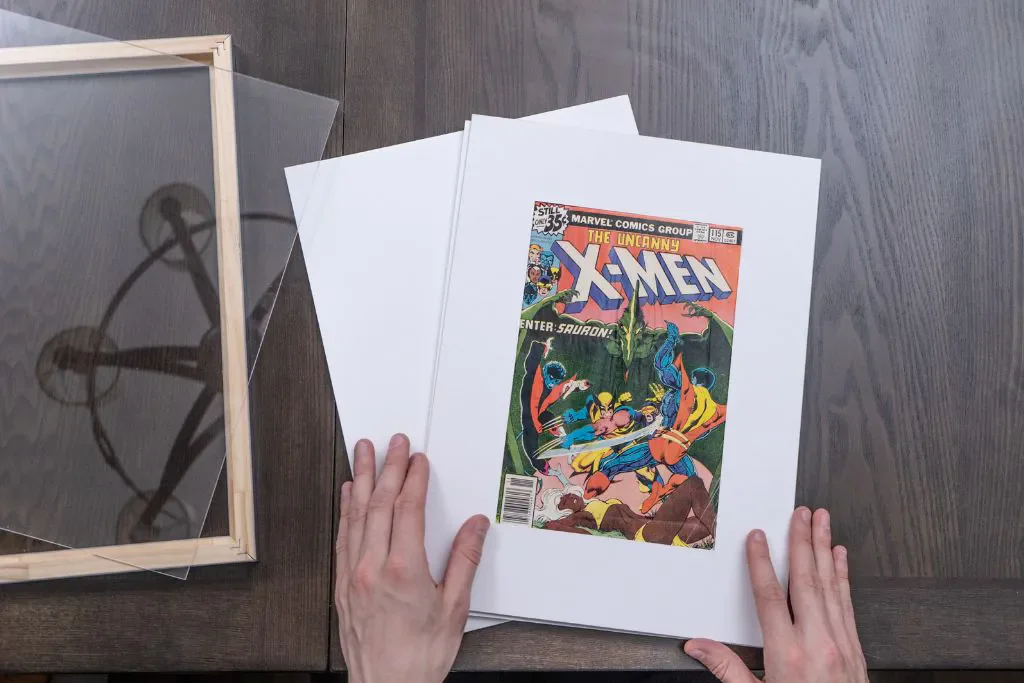
Each era has slightly different dimensions because the magazine industry standardized comic page sizes differently across decades. When ordering a frame, measure the actual comic.
Three approaches to framing

Approach 1: Bare comic, no protective sleeve
Frame the comic directly behind acrylic, with the comic mounted on a backing board using photo corners.
When this works: for low-value comics where the customer just wants the cover visible. Modern reprints, newer comics, or duplicates.
When this fails: for any comic with collectible value. Direct mounting touches the comic surface, doesn't protect against humidity changes, and can damage the spine when the comic is removed.
Skip this approach for anything you might want to grade or sell later.
Approach 2: Comic in a top-loader, framed
A top-loader is a rigid clear plastic sleeve that holds the comic flat. The comic slides in, the top closes. The whole thing is then placed inside the frame.
When this works: for comics in good condition that you want to display safely. The top-loader prevents direct contact with the frame's mat or backing. It's reversible, you can remove the comic from the top-loader and the frame at any time.
Frame size: about 7.5 by 11 inches outer dimension at minimum, depending on the top-loader brand. A 9x12 outer frame with a centered mat opening for the top-loader works well for most modern comics.
Mounting: the top-loader can be held in place inside the frame with strips of acid-free linen tape on the back, or with photo corners cut large enough to wrap around the top-loader's edges.
This is the most common framing approach for collectors. The comic stays protected, can be removed easily, and the display is clean.
Approach 3: Graded slab (CGC, CBCS, etc.)
A graded slab is a comic that has been professionally graded and sealed in a hard plastic case. CGC (Certified Guaranty Company) and CBCS (Comic Book Certification Service) are the two major graders. The slab includes the grade label and is permanently sealed.
When this works: for valuable comics. The slab preserves the grade indefinitely and the framing protects the slab from physical damage.
Frame size: CGC and CBCS slabs are roughly 8.6 by 11.4 inches. The frame should accommodate the slab plus a small margin for inserting and removing it.
Mounting: slabs are too thick to use top-loader mounting. They sit in a recessed shadow-box-style frame with a snug fit.
For graded comics, the framing is essentially a protective display case. The slab does the preservation work.
Frame depth requirements
The frame depth depends on what's inside.
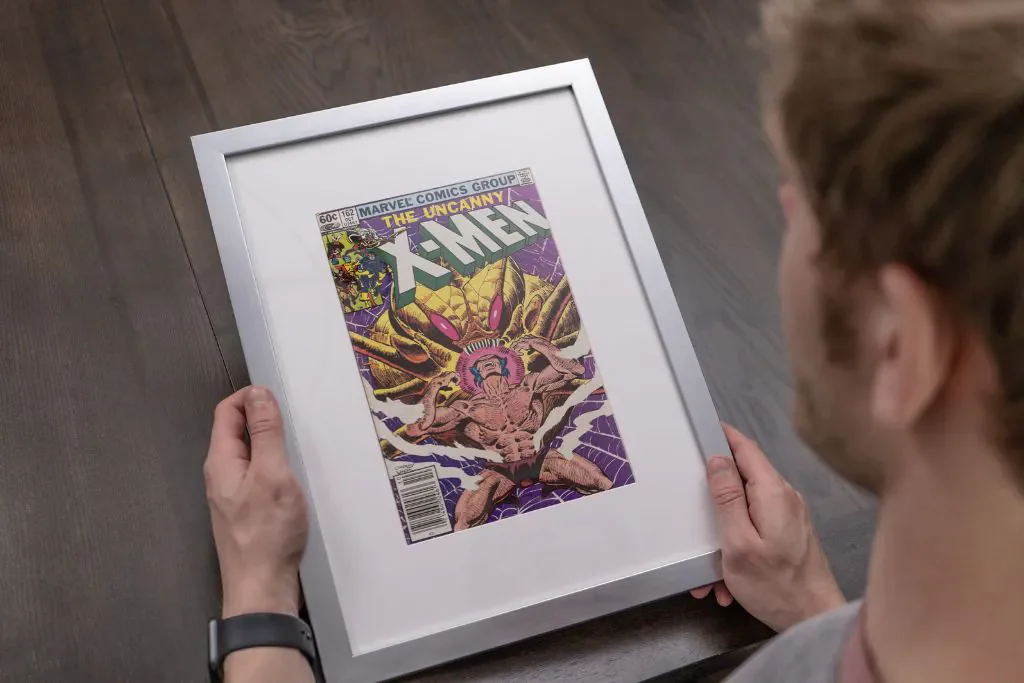
Bare comic with photo corners: 1/2 inch depth (just acrylic, mat, comic, backing).
Comic in a top-loader: 3/4 inch depth (the top-loader is about 3/16 inch thick).
Graded slab: 1 inch depth or a shadow box at 1.5 inch depth (the slab is about 1/2 inch thick plus mounting clearance).
For a slab in a flat frame, use a frame with at least 1 inch of internal clearance. Shadow boxes work for slabs that need extra depth or for displays with multiple slabs side-by-side.
The mat, what color, what cut
For comic framing, the mat is partly decorative and partly structural (it holds the comic or slab in place).

Color: black is the most common choice. It anchors the comic visually and doesn't compete with the cover art. Cream or off-white works for vintage comics where a softer aesthetic is appropriate. School-color or character-color (red for Spider-Man, navy for Batman, etc.) is a personality choice.
Mat opening: sized to the comic or top-loader or slab. For a top-loaded comic, the mat opening is cut to roughly 7 by 10.75 inches (a 1/4 inch reveal of the top-loader edge on all sides). For a slab, the opening is cut to fit the slab's outer dimensions with the grade label visible at the top.
Mat width: 2 to 3 inches around the comic. The mat width gives the comic proportional weight in the frame.
Glazing
Framer's grade acrylic is the right call for comic framing. Comic book covers are color-printed on relatively cheap paper that fades faster than fine-art prints, so keeping the display out of direct sunlight matters more than the glazing choice. A comic in a sunlit room fades visibly within 5 to 10 years no matter what is in front of it.
For graded slabs, the slab itself provides a layer of protection in its plastic. Either way, framer's grade acrylic in the frame keeps the cover clearly visible.
For valuable comics or slabs, the sealed frame keeps dust from settling on the cover and slab.
Multi-comic displays
For displaying multiple comics together (a set, a story arc, a character collection), the frame holds 4 to 9 comics in a grid layout.
Common configurations:
- 2x2 grid (4 comics) in a 16x20 outer frame
- 3x3 grid (9 comics) in a 24x36 outer frame
- 1x4 horizontal row in a 32x12 outer frame (long and narrow)
Each comic gets its own mat opening, sized identically across the grid. The mats are typically all top-loaders for protection, all slabs, or all bare. Mixing approaches in one frame looks inconsistent.
Frequently asked questions
Will framing my comic affect its grade?
If the comic is already graded (CGC or CBCS), the slab is the grade, opening or modifying the slab destroys the grade. Framing the slab inside a frame doesn't affect the grade because the slab is sealed.
For ungraded comics, framing in a top-loader without direct contact preserves the comic's condition. Framing with adhesive or direct contact can damage the comic and lower its eventual graded condition.
Should I get the comic graded before framing?
For valuable comics (Silver Age key issues, first appearances, signed comics), yes. Graded slabs preserve the grade indefinitely and are easier to authenticate later. The grading fee (50 to 100 dollars per comic) is worthwhile for any comic worth more than 200 dollars.
For modern comics, top-loader framing is usually enough.
Can I frame multiple covers from the same issue?
Yes. Variant covers from the same issue can be displayed together in a multi-comic frame. Common approach: the standard cover at center, variants arranged around it.
Will the cover fade behind the acrylic?
Keeping the display out of direct sunlight slows fading dramatically. With framer's grade acrylic and an indoor spot away from direct sunlight, fading is minimal over decades. In a sunny room, fading is visible within years no matter the glazing.
Can I open the frame later to add or change comics?
With a removable back, yes. We build all our comic frames with screwed (not glued) backs so the contents can be accessed.
The goal is for the comic display to look the same in 30 years as it does the day it ships. Done right, it does.